An invitation to Little, Brown Books for Young Readers
A book opens a world.
Feedback opens the next door.
Reading & Writing Studio turns a story into a guided cycle of reading, thinking, writing and revision.
A working web app. An educator at the helm. A proposal to bring The Wild Robot into a growing, licensed learning library.
Partnership discussion draft · 25 October 2026
Prepared independently by AV Labs. No publisher affiliation implied.
The product comes first
Step into the Studio.
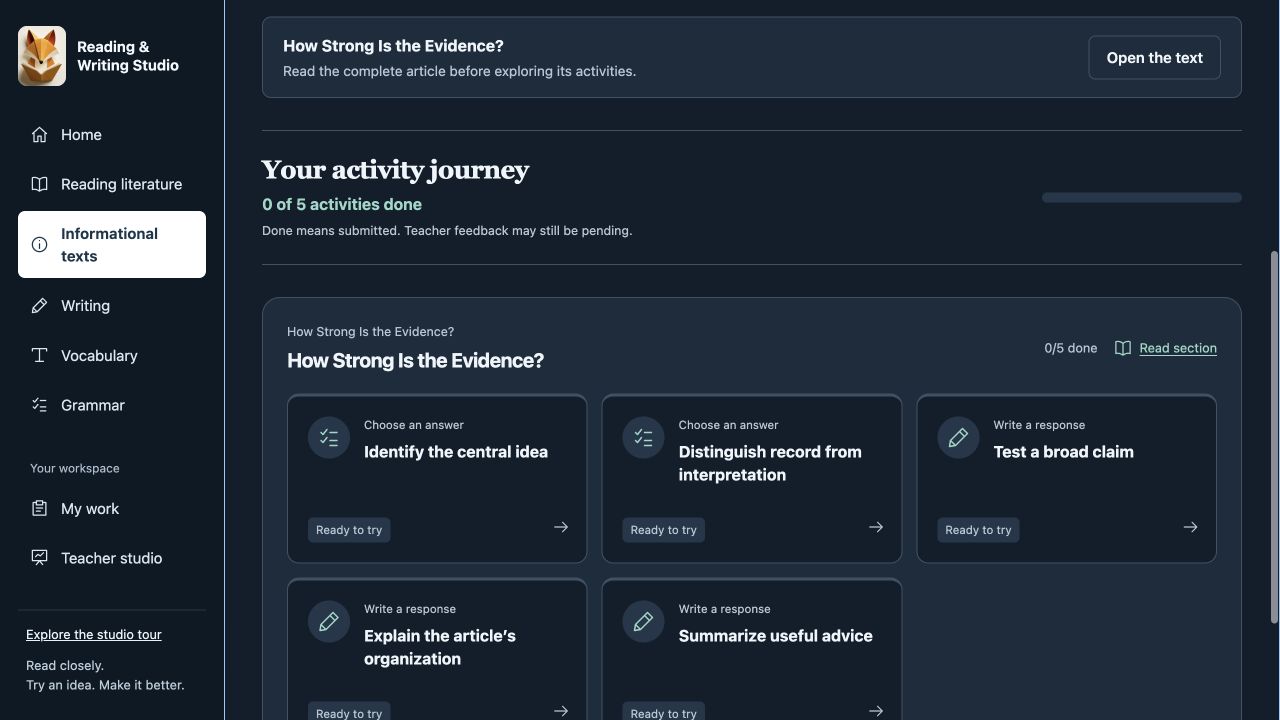
Choose a book. Save your place. Find the words you need. Write something worth improving.
The doorway opens the working app in a new tab. Try the Studio tour to explore reading, feedback and teacher insights using demonstration content.
 Enter the Studio
No private teacher login is included. The Wild Robot shelf entry is an unavailable concept, not a licensed unit.
Meet the founder
A teacher who can
build the classroom tool.
Founder & Developer, AV Labs
Ontario College of Teachers licensed teacher
David brings international experience in English language arts, English as an additional language and learning support. His work connects curriculum design, differentiated instruction, practical AI training and hands-on software development.
That combination keeps the product close to the classroom: the founder can design the learning sequence, build it, observe where learners struggle and improve it.
 Aninvieve Labs Corporation
Explore AV Labs ↗
The learning problem
The gap is between
“submitted” and understood.
A child can finish a worksheet without knowing how to improve an answer.
For the learner
“Wrong” is a verdict. A useful next step explains what to keep, what is missing and where to look.
For the teacher
Answers, drafts, rubrics and reading progress need to tell one coherent story—without grading every response twice.
For the publisher
A great title can anchor a sustained classroom experience, with a clear path from discovery to reading, discussion and writing.
These are the product’s design hypotheses. A classroom pilot will test their impact.
The core experience
Feedback that leads
to another attempt.
The important moment is what the learner does next.
Explain how Buck changes, using evidence from the text.
This is an authored explanation of the intended learning cycle, not a live AI evaluation or measured student result.
How feedback works today
Built around meaning.
Honest about uncertainty.
Expected ideas, acceptable variations, passage locations, common misconceptions, hints, rubrics and annotated models.
Recognizable ideas, completeness, evidence selection and quotation presentation. Spelling is not a comprehension penalty unless it is the skill being assessed.
Acknowledge what is demonstrated. Offer a focused hint or multiple-choice clarification. Let the student revise before comparing with a model.
Unrecognized interpretations go to review. Suggested feedback stays separate from teacher-confirmed scores.
Why we do not call the current system a live AI essay grader
The current release uses prepared guidance and recognition rules. It cannot reliably interpret every original essay or infer that a quotation supports any possible argument. Model-answer similarity alone is not sufficient for grading. Authored banks support the demonstration now; funding would support evaluated model integration, teacher calibration and wider response coverage.
A model answer is released at the final comparison stage. It helps students understand quality without replacing their first attempt.
What investment unlocks
The next AI layer:
more understanding, same teaching purpose.
The opportunity is to combine flexible language interpretation with a teacher-designed learning sequence.
Ground model feedback in the actual passage, question, rubric and reviewed answer bank. Evaluate paraphrases, partial understanding and alternative interpretations beyond recognizable wording.
Respond to the specific gap, offer a graduated hint and preserve the learner’s next attempt. Compare revision against the same criteria; release the explained model at the final stage.
Build a teacher-scored benchmark of varied answers, including multilingual writing, ambiguous evidence and misconceptions. Track agreement, false corrections, usefulness, latency and cost per completed feedback cycle.
Route uncertainty to review, retain response versions and distinguish suggested feedback from approved grades. Establish provider/data controls and prevent student text from overriding the assessment instructions.
Planned development. No live model API, automatic essay-grading accuracy or future operating cost is claimed today.
AERO alignment
A learning purpose
behind every activity.
Grade 6 AERO English Language Arts benchmarks connect the task, feedback, rubric and teacher evidence.
| Learning opportunity | AERO reference | Evidence to review |
|---|---|---|
| Explain a character’s response or change | RL.3(a) | Claim, episode and explanation |
| Support a literary inference | RL.1(a) | Relevant passage and reasoning |
| Analyze an informational text | RI.1(a) | Textual support for an interpretation |
| Develop explanatory writing | W.2(b) | Relevant facts, details and examples |
Mapping is visible in the Studio. The framework can be extended to other curricula through a deliberate standards crosswalk and content review.
AERO alignment is not accreditation, proof of mastery or complete annual coverage. Benchmark labels here are paraphrases. Framework source and scope.
Teacher insights
A classroom picture,
not another pile of answers.
The dashboard brings together chapter and activity progress, submitted versions, feedback, rubric criteria and revisions. Teachers can inspect the work behind a skill signal, comment, score and request another attempt.
Export one learner, selected work or a whole class with rubrics, model answers and an optional external-AI review prompt. Teachers decide where to upload it and approve the resulting grades.
Missing work is not a zero. Completion is not mastery. Actual demonstration accounts are fictional; the preview above uses invented numbers to explain the view.
Designed for different readers
Make the next page
feel possible.
Literature and informational texts share one calm, consistent learning space.
- Chapter navigation, saved bookmarks and autosaved writing
- Plain-language introductions, vocabulary glossaries and refresher lessons
- Optional OpenDyslexic, text-size and spacing controls, light and dark modes
- Reading, writing, grammar and Greek/Latin word-part practice
- Progress boards that distinguish drafts, submissions and revisions
- Chapter work leading toward extended writing and summative projects
The Wild Robot · proposed flagship
Start with a story
that invites big questions.
Peter Brown’s story brings nature, technology, survival and belonging into the same conversation.
Little, Brown Books for Young Readers publishes The Wild Robot, listed for ages 8–12. Its themes offer a compelling starting point for a Grade 6 experience connecting literary interpretation, evidence-based writing and age-appropriate informational texts about technology.
Proposal only. No text, illustrations, character artwork or film assets from The Wild Robot are included in this deck. Official publisher listing ↗
The partnership opportunity
Your books.
A deeper learning journey.
AV Labs brings
- A working reading-and-writing platform
- Educator-led curriculum and product development
- A feedback, assessment and reporting foundation
- A founder able to demonstrate the product and support teacher onboarding
We invite the publisher to bring
- The appropriate rights and editorial collaboration
- Milestone-based development or pilot sponsorship
- School/library marketing expertise and introductions
- A jointly selected path to a wider collection
Build a classroom pathway around the book, while preserving the value of the book itself.
Potential benefits include sustained title engagement, approved purchase or class-set links, reusable educator resources and aggregate pilot insight. Those outcomes must be measured; they are not promised sales.
Rights and partnership structure
Confirm the actual rights holders and agree titles, territories, languages, term, permitted display/excerpts, artwork, accessibility and any AI processing. Model training on licensed content is not assumed. Commercial terms, IP ownership, reporting and expansion rights require a separate agreement. Sponsorship, licensing and equity are distinct options; no equity or exclusivity is offered in this draft.
The collection vision
One flagship today.
A library worth returning to tomorrow.
The platform already separates books, chapters, activities, standards and feedback guidance. Each new title still deserves editorial care.
The reusable software foundation reduces repeated implementation. Content sourcing, answer guidance, assessment design and quality assurance remain real work for every book.
Market entry and commercial model
Start focused.
Earn the right to expand.
The initial audience is upper-primary and middle-school English language arts classrooms, including multilingual learners.
A strategic publisher sponsors a licensed flagship unit and a small, approved classroom pilot. Student access is free within that pilot.
Educator demonstrations, publisher school/library channels and carefully measured outreach support adoption. David can lead onboarding and founder-led demonstrations.
License additional titles, then test school or institutional pricing for advanced teacher workflows. Preserve an accessible student experience; do not depend on advertising to children.
Where this sits among existing options
Teacher packets offer ready-made activities; general AI chats offer flexible responses; learning platforms organize assignments. The Studio aims to connect the book, task-specific feedback, revision history and teacher evidence in one experience. This is a product-positioning hypothesis, not a claim that no competitor offers these capabilities. Pricing, willingness to pay, retention and unit economics still require validation.
Evidence and readiness
A working foundation.
A measurable next chapter.
These are engineering receipts, not customer traction. No paid adoption, classroom learning gains or publisher partnership is being claimed.
What the pilot should measure
- First-attempt to revision quality, scored against a shared rubric
- Agreement between feedback and independent teacher judgments
- Incorrect rejection of valid interpretations and missed misconceptions
- Teacher review time, learner task completion and return use
- Reliability, accessibility issues and actual support cost
What still needs investment
- Teacher-reviewed feedback benchmarks and evaluated live-model integration
- Licensed content and editorial quality assurance
- A real classroom pilot under an approved data process
- Recurring backup/recovery operations, monitoring and scale controls
- Assistive-technology testing, including the deferred spoken screen-reader check
The 50-account run was an HTTP workflow test, not 50 simultaneous browser users. Test results do not establish production scale or educational efficacy.
Proposed 12-month development journey
Four milestones.
One shared learning agenda.
- Months 1–2
Agree and prepare
Rights, flagship scope, teacher advisory input, baseline assessment plan, privacy and pilot requirements.
Gate: approved scope and measurable success criteria. - Months 3–5
Build and calibrate
Licensed unit, reviewed answer banks, models and rubrics; evaluate live AI against teacher-scored responses.
Gate: content review and agreed feedback-quality threshold. - Months 6–9
Pilot and improve
Recruit a small approved cohort, support teachers, test accessibility and reliability, study revision quality.
Gate: evidence review, unresolved-risk log and cost report. - Months 10–12
Publish the findings. Plan the library.
Refine the product, prepare educator resources and a measured marketing plan; select expansion titles together.
Gate: joint go/no-go for additional investment.
Proposed sequence, not contracted delivery dates. Larger catalog, immersive library navigation, narrated introductions and additional standards frameworks belong in the expansion roadmap.
Indicative partnership request
Fund the next chapter.
Measure what it unlocks.
For a proposed 12-month flagship development and pilot program.
Funding would buy focused founder development time and specialist review, tied to agreed milestones. A broader collection could be scoped around a larger envelope, such as CAD 150,000, after title selection and cost validation.
Illustrative allocation—not vendor quotations, a valuation or a binding offer. CAD is a draft assumption. License fees and applicable taxes need separate costing. A five-title expansion is not promised at this price.
The next conversation
Let’s build the bridge
from a loved book to a stronger writer.
A 30-minute product and partnership discussion with the relevant children’s publishing, rights and school/library team.
We would walk through the Studio, explore a licensed The Wild Robot pilot, identify the correct decision-makers and agree whether to scope the next step together.
For other investors: the same milestones support a product-validation conversation. A publisher license and an investment decision remain separate.
Sources & scope
This independent discussion draft combines a verified publisher route, current product evidence and proposed future work. Research checked 25 October 2026.
- Hachette official title listing — publisher, author, age range and title context.
- Hachette rights and permissions guidance and imprint contact routes — routing, not a confirmed investment program.
- AERO ELA framework hosted by NESA — original Grade 6 framework used by the app; latest edition not established. The app retains source transcription and activity mapping. The source URL was unavailable during this pitch check.
- Sequoia: Writing a business plan and Y Combinator: seed fundraising guide — structure adapted for a strategic publisher partnership.
- Product evidence: AV Labs release fc715a9, 25 October 2026 readiness report; earlier authenticated test receipts. Founder credentials: owner-confirmed professional record. No independent credential-register check is represented.
Original journey imagery created with Grok Imagine. AV Labs mark used from the owner’s brand assets. The fantasy setting is original; no connection with any existing fantasy franchise is implied.
Journey draft · Nothing sent to the publisher · © 2026 Aninvieve Labs Corporation
Return to the beginning ↑